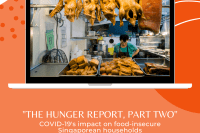
"The hunger report, part two": COVID-19's impact on food-insecure Singaporean households

“The hunger report, part two”: COVID-19’s impact on food-insecure Singaporean households

Last year, the Lien Centre for Social Innovation published Singapore’s first nationally representative food insecurity study, finding that about 10 per cent of Singaporean households experienced food insecurity at least once in the last 12 months. This year, the centre’s updated, second part of “The Hunger Report” explored two related questions. First, what is the impact of the COVID-19 pandemic on food insecurity in Singapore? And second, how can the unique needs of food-insecure families be met? We take a deeper dive into the report with members of the report team, Dr. Dalvin Sidhu, Dr. Tania Nagpaul, and Ms. Ng Weng Lin.
COVID-19, over 716 days later (Photo by Ng Shi Wen)

COVID-19, over 716 days later: Confronting Singapore’s long-term, pandemic-linked social challenges

So much ink has been spilled on Singapore’s healthcare and public health response to the ongoing pandemic. Yet, there will be an end to COVID-19, and the start of 2022 feels like a good time to shift some of the public focus to our country’s long-term, pandemic-linked social challenges. In this short episode, I summarise the most urgent and obvious problems – migrant, healthcare, and economically disadvantaged essential workers – before detailing four challenges which have received less attention: First, the harm to children, adolescents, and youths; second, compounded socio-economic inequality; third, social isolation; and fourth, ambiguous loss and unresolved grief.

Green serving tray on a selection of canned beverages

“The hunger report”: Singapore’s first nationally representative food insecurity study

While reports of food insecurity have previously featured in the media, Singapore’s first nationally representative food insecurity study documented that about 10 per cent of Singaporean households experienced food insecurity at least once in the last 12 months, and that only 22 per cent of these food-insecure households were receiving food support from an organisation. Published by the Lien Centre for Social Innovation and supported by The Food Bank Singapore, “The hunger report: An in-depth look at food insecurity in Singapore” also reports causes and consequences of food insecurity and offers recommendations.

A HDB block with clothes left out to dry

“Mind the chasm”: The pandemic’s devastatingly uneven impact and the insecurities of low-income families across multiple, intersecting dimensions

This month, in the same week that the Department of Statistics revealed that households in the bottom 10 per cent were the group hit hardest by the COVID-19 pandemic, with their monthly total earnings from work falling by 6.1 per cent, Beyond Social Services published its “Mind the Chasm” report.

Fresh bear garlic on wooden table with knife

Food insecurity in Singapore: Tackling the root causes of hunger, not just intervention mechanisms

Through a two-part series – the first documenting the 4.1 per cent of Singaporeans facing moderate to severe food insecurity (CNA, Feb. 16) and the second evaluating the over 100 food assistance groups helping those in need (CNA, Feb. 23) – Channel NewsAsia (CNA) cast additional light on a phenomenon which demands greater attention on its root causes, not just the shortcomings of existing intervention mechanisms. In other words, how do we prevent Singaporeans from going hungry in the first place, and if they do experience food insecurity what are the more effective, not just more efficient, ways of dealing with the problem?