Hallway of a HDB flat in Singapore

“HDB home buyers don’t want public rental blocks in vicinity”: The challenge of research methodology and social integration in Singapore

Although the journal article was ostensibly focused on Singaporean perceptions of the Ethnic Integration Policy (EIP) – and how this housing policy may influence the decisions of home-owners when choosing a flat – the ST article zoomed in on the preferences of home-owners to not live close to HDB public rental blocks (ST, Mar. 22). It cited the lead researcher, Associate Professor Leong Chan-Hoong of the Singapore University of Social Sciences, who concluded: “After price and location, proximity to public rental flats would be the variable that discourages a person from buying a unit”.
Classroom in Brazil

Better social mix of students in IP schools than non-IP ones? Challenging measures of “social mixing”

How social mixing in schools is defined and measured determines how student diversity is evaluated, and it is therefore worth challenging Education Minister Ong Ye Kung’s claim that “the social mix of students in Integrated Programme (IP) schools is actually better than that in non-IP schools” (ST, Dec. 27). The metric used by the Ministry of Education (MOE) is that “every 100 Secondary 1 students in a school should come from 20 or more primary schools”. A school with 300 secondary one students, as inferred, should have these students hailing from at least 60 different primary schools. Based on this too, MOE should be able to track the total number of primary schools represented in each secondary school’s secondary one cohort.

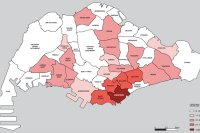
Map illustrating the distribution of street homeless people in Singapore

“Homeless in Singapore: Results from a nationwide street count”: Putting the “1,050 street homeless people” in context

Ng’s (2019) excellent and policy-relevant research was characterised by robust data collection – using two different types of counts and involving social service agencies in the research – the creation of a base (figure) for future research and for regular counts longitudinally, as well as the pairing of the causes of homelessness with policy recommendations. Two limitations, nonetheless, should be flagged. The absence of: First, contextualisation of the 921 to 1,050 street homeless people in Singapore, especially in comparison to other developed countries or cities where, as mentioned in the publication, counts of homeless populations are part of regular policy activity; and second, substantive and empirical attention linked to the family and community networks of these individuals.

Dakota train station

“‘Bridges and ladders’: The paradox of equity in excellence in Singapore schools”: The problem of inequality beyond the schools

That the Singaporean discourse on inequality has centred disproportionately on schools and the education system is unsurprising, especially since meritocracy remains perceived as the country’s main principle of governance. Yet, notwithstanding the elitism and lack of demographic representation associated with top schools, if sources of inequality stem from economic or labour policies, the hypothesis that the education system could in fact be mitigating the effects of socio-economic disparities should be taken more seriously.

Graduation at Marina Barrage

““Getting ahead in Singapore”: How neighbourhoods, gender, and ethnicity affect enrolment into elite schools”: Using JC yearbooks as data

Given the challenges associated with obtaining complete data of the socio-economic diversity of Singapore’s top schools, Chua et al.’s (2019) research strategy of using 40 years of junior college (JC) yearbooks (1971 to 2010) as data – to study the influence of neighbourhoods, gender, and ethnicity on elite school enrolment – is therefore a very interesting workaround.