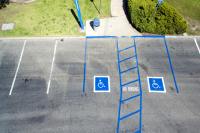
Disability parking spaces

The employment of persons with disabilities: Accounting for employment satisfaction and discrimination claims

A CNA article brought critical attention to the challenges that persons with disabilities (PWDs) face when looking for a job in Singapore (CNA, Mar. 22). Currently, 28.6 per cent of PWDs aged 15 to 64 are employed – mostly in “community, social and personal services, food services, administrative and support services and manufacturing” – and another 4.2 per cent who fall within this age range are unemployed but actively looking for employment. Yet, at the same time, it would be productive to also focus on employment satisfaction among those who have a job as well as increase awareness of and examine discrimination claims.

Hallway of a HDB flat in Singapore

“HDB home buyers don’t want public rental blocks in vicinity”: The challenge of research methodology and social integration in Singapore

Although the journal article was ostensibly focused on Singaporean perceptions of the Ethnic Integration Policy (EIP) – and how this housing policy may influence the decisions of home-owners when choosing a flat – the ST article zoomed in on the preferences of home-owners to not live close to HDB public rental blocks (ST, Mar. 22). It cited the lead researcher, Associate Professor Leong Chan-Hoong of the Singapore University of Social Sciences, who concluded: “After price and location, proximity to public rental flats would be the variable that discourages a person from buying a unit”.

“Households with maids use 20 per cent more water”: Correlation is not causation

Careful reporting of survey findings is important. Focusing disproportionately on the observation that households with foreign domestic workers use 20 per cent more water than those without (ST, Mar. 9) – 160 litres compared to 135 litres, on a daily, per-capita basis – and attributing the higher water consumption to the hypothesis that “washing and cooking activities are done more often in homes with maids” results in two problems. First, the conflation of correlation and causation, especially when other factors potentially related to consumption, besides the number of individuals in a household, have not been adequately considered; and second, relatedly, the leap to a causal explanation without convincing empirical evidence.

Mental health

Tackling mental health issues: Improved data collection, presentation, and collaboration

Even though a survey conducted by nominated MP Anthea Ong and her team of volunteers yielded some useful insights about the accessibility and affordability of mental health treatment in Singapore, from a research perspective more data is still needed to better understand the state of mental health in the country. In fact, the concession that the survey was “not an official study aligned to rigorous standards of academic research” (ST, Mar. 5) should bring attention to the need for improved data collection, presentation, and collaboration.